Spirits competition judging sounds like a cushy gig. There’s definitely worse ways to make a living.
Though it’s not quite sitting in a velvet armchair, swirling a glass, declaring it magnificent, and disappearing into a cloud of pipe smoke.
You evaluate dozens of spirits, often across long sessions, and are expected to provide specific, useful feedback on each one.
Tips for the trade
It is fun, yes. It is also technical and weirdly physical. Imagine blind speed dating 50 whiskies in a few hours, except you have to score each one, explain yourself, stay alert, manage your palate, and not accidentally award a medal because you got hungry and emotional around sample 37.
If you work in retail, distribution, production, bartending, buying, writing, education, or any other corner of the trade where your palate matters, there’s a decent chance you’ll be asked to judge someday.
I’ve done it plenty of times myself, most recently taking part in this year’s International Spirits Challenge, one of the world’s major dedicated spirits competitions. There was, disappointingly, no robes, chanting, or secret handshake. Just flights of blind samples and a scoring sheet waiting to expose whether you actually know what you’re talking about.
This is what I learned.

Think you’ve got what it takes to judge a spirits comp?
The Dos and Don’ts of Spirits Competition Judging
Understand the brief
Before you put your nose anywhere near a glass, understand the process. How are the spirits grouped? Are you judging by category, region, style, age, ABV, or some combination of all of those? Are you scoring out of 20, 100, or assigning medals? Is there an expectation to comment on appearance, aroma, palate, finish, balance, or commercial quality?
At the ISC, samples are delivered in flights and assessed blind, with information such as flavour profiles and ABV range available on the score sheet. Spirits are assessed according to region, style, and age, and each judge scores independently before the panel discussion begins.
Context informs everything. You cannot judge a young grain whisky, a high-strength bourbon, and a delicate Canadian whisky as if they all set out to do the same thing.
Ask questions and double check
There is no such thing as a stupid question.
Need any information? Ask. Unsure where to put your score? Ask. Forget to get the WiFi password? Ask.
There is no sense in wasting your time and theirs. Clarity beats ego every time.
Always be prepared
The Boy Scouts were on to something. Bring what you need to work comfortably. The ISC scores are taken digitally via Google Docs.
That means a laptop, charger, mouse, if you use one. Dress practically. Being too hot, soaked through, pinched by shoes, or distracted by some ambitious outfit choice does not help.
Water is typically provided, but there’s no harm in having a back up bottle. Have your notes to hand. Pen and paper contingencies, even if the scoring is digital, because technology loves choosing violence at exactly the wrong moment.
Don’t dampen your senses
Your nose is the main tool. Don’t ruin it before you begin.
Avoid perfume, aftershave, strong deodorant, heavy coffee, spicy food, and anything else that elbows its way into your sensory system. Eat plainly beforehand. Drink water. Keep things simple. If you are judging in the morning, breakfast should support your palate, not challenge it to a duel.
If you can smell yourself, everyone else can too.
Calibrate your palate early
Your first few samples matter because they help set your range. Don’t go charging in with dramatic scores before your palate has found the room. Taste carefully, think about the category, and pay attention to how your fellow judges talk about quality markers.
You are not trying to copy them, but you are trying to understand the shared standard at the table. A Gold medal should mean something. So should Silver, Bronze, and no medal.
This is especially important when the first sample in a flight is very good, very poor, or very unusual. Extremes can drag your scoring around if you are not paying attention. Set your scale before you start swinging it around.

Former MoM editor Henry Jeffreys demonstrates expert nosing technique here
Pace yourself
You cannot rush this process. You also cannot attack the glass like you are trying to inhale it whole. The spirit isn’t going anywhere.
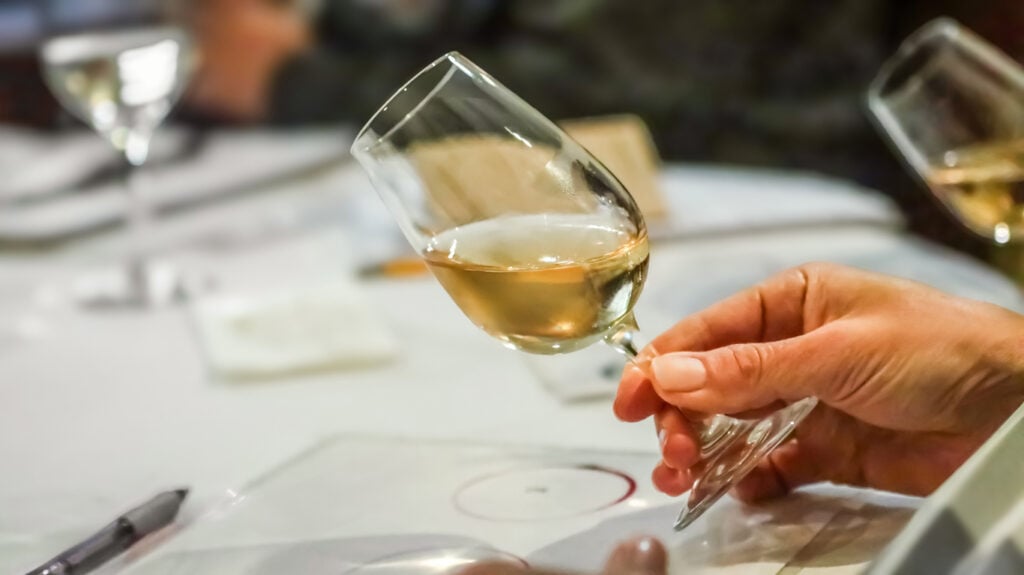
Approach gently. Bring the glass towards you. Keep your mouth slightly open when nosing, which helps soften the alcohol vapour and lets more detail come through. Taste in small amounts. Return to samples where needed.
Give yourself a moment between glasses. Water helps. So does breathing.
Don’t underestimate the workload
Two three-to-four-hour sessions of focused nosing, tasting, scoring, and discussion is work. Rewarding, definitely. But still work.
There is a level of concentration and sensory awareness required that feels very different from casual tasting. You are not simply asking yourself whether you like something. This is about asking whether it is well made, expressive, balanced, technically sound, and deserving of recognition in its category.
You are not scoring your personal favourites, but judging quality. And while judging is a privilege, it is not a jolly.
Write notes that mean something
Useful judging notes are specific. Fruit is a start, but it is not enough.
What kind of fruit? Orchard fruit? Citrus? Tropical fruit? Dried fruit? Cooked fruit? Candied fruit? Think about texture. Is the sweetness balanced or cloying?
Remember what this is for. Producers need useful feedback, not decorative adjectives. Nobody is impressed that you know what Seville orange marmalade tastes like.
Look for balance, not just fireworks
Big flavour is exciting, but judging is not a loudest-dram-wins contest. Volume is not the same as quality.
A whisky can be intense and still lack balance. It can be subtle and still show real quality. Look for integration, texture, development, finish, and whether the spirit feels complete.
This is where trade experience matters. Anyone can spot obvious flavour. Good judges can assess structure.

Judges hard at work at the IWSC 2026
Back yourself
Strong judging panels include people from different parts of the trade for a reason. Distillers, bartenders, buyers, writers, educators, and producers all bring different expertise.
Your perspective matters. That is why you are there. You do not need to dominate the table, but you should not shrink from giving your view either. If you think a whisky deserves better, say why. If you think it falls short, say why. Bring evidence, not vibes.
Just make sure you prepare. Research is everything. Understanding what makes a bourbon a good bourbon means you get a framework of what to look for built in.
Don’t ignore your biases
Everyone brings bias to the table. Anyone who says they don’t is either lying or has never met themselves.
You get tired, hungry. Everyone has preferences for certain styles. You may reject something unfamiliar before you have properly understood it. That is human, which is precisely why good judging systems build in checks, discussion, re-tasting, and panel consensus.
Blind tasting helps. So does humility. Notice your instincts, then test them.
Debate without being a pain
Good judging can involve disagreement. If everyone at the table always agrees instantly, something odd is happening.
The useful version of debate is specific. You discuss balance, integration, nose, palate, finish, flaws, category expectations, and whether a spirit deserves Bronze, Silver, Gold, or no medal. If something sits on the edge, it may be re-evaluated. Judges may be asked if they are willing to reconsider. Sometimes they are. Sometimes they are not. Then the process moves on.
Good judges listen as well as taste. You are there to contribute, not perform a live podcast nobody requested. The key is to argue the liquid, not your ego.
Use the spittoon
Seriously. Use it.
You cannot properly judge dozens of spirits if you are swallowing every sample. That is not dedication. That is amateur hour wearing a lanyard.
Spitting keeps your head clear, your palate sharper, and your judgement more reliable. It’s professionalism, not weakness.
Manage palate fatigue
Palate fatigue is real. So is nose fatigue. After enough samples, everything can start to blur unless you actively manage yourself.
Use water. Pause when allowed. Smell your sleeve or a neutral part of your clothing if you need to reset. Give your nose a moment. Avoid constantly returning to every glass, because you can overwork yourself into confusion.
Also watch for the sample-order problem. A spirit tasted after something huge, hot, smoky, or heavily oaked can seem quieter than it really is. That does not mean it lacks quality. It may simply be standing next to a brass band.
We hope these tips prove useful to you. Happy judging!
Take your health seriously
If you feel unwell, tell someone. Judging rooms are controlled environments, but long sessions, alcohol vapour, concentration, travel, and fatigue can still catch up with you.
There is no medal for powering through while your body is quietly filing a complaint. Look after yourself. The whisky can wait.
Don’t treat results like gossip
Judging often involves confidential samples, unreleased products, and sensitive commercial information.
Do not wander off and start hinting about what you think you tasted or who you think entered what.
Blind judging works because everyone respects the process. Keep it professional before, during, and after.
Enjoy it
For all the seriousness, it is still a brilliant thing to do.
Sitting around a table with experienced spirits people and discussing the balance, flavour, nose, finish, and quality of whiskey is a genuine privilege.
You taste excellent spirits. Flawed spirits. Weird spirits. You learn from all of them. From the people next to you.
There are worse gigs. Plenty of them involve spreadsheets and no whisky.
We’re always interested in hearing about new launches, producer stories, category insight, venue news, and trade ideas worth sharing. If you’ve got something our buyers, bartenders, retailers, or drinks industry readers should know about, get in touch by emailing content@masterofmalt.com.